Best Alternatives to SWIFT for Fast Cross-Border Transfers
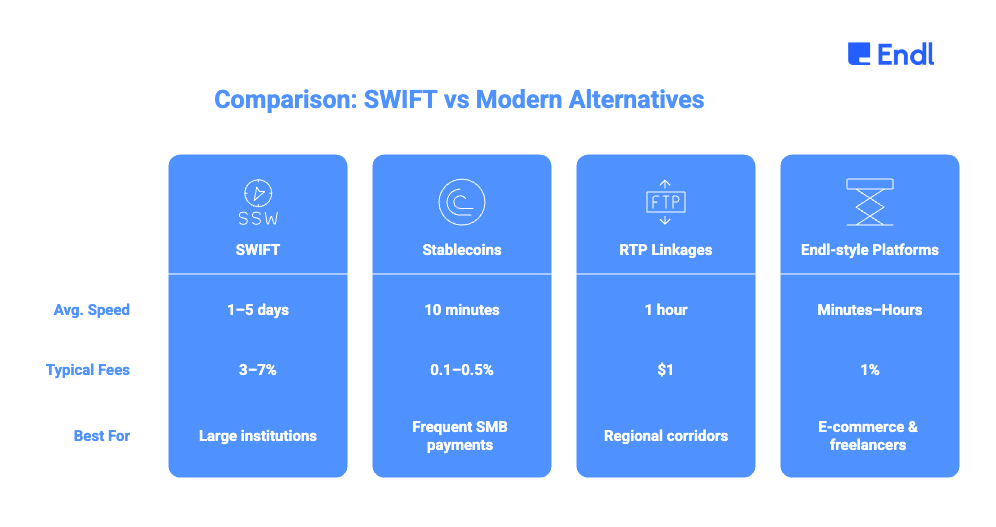
Although SWIFT (Society for Worldwide Interbank Financial Telecommunication) has long been the industry standard for secure international bank messaging, its reliance on correspondent banking networks often results in delays of 1–5 working days and high fees (3–7% per transfer).
A number of modern alternatives now use fintech infrastructure, blockchain networks, and real-time payment rails to reduce costs to less than 1% and settle transactions in minutes or hours. These SWIFT alternatives are particularly relevant for SMBs, freelancers, and e-commerce businesses that rely on frequent international payments.
Key Limitations of SWIFT for Cross-Border Payments
SWIFT allows banks to communicate with each other, but it does not move money directly, forcing transactions through multiple intermediaries. This results in:
- Correspondent bank fees: often hidden, typically $20–50 per leg
- FX markups: commonly 2–4% above market rates
- Settlement delays: slow Nostro/Vostro reconciliations
- Limited transparency: no real-time tracking until final settlement
These issues disproportionately impact small businesses, independent contractors, and online merchants handling regular cross-border transfers.
Best SWIFT Alternatives for Faster International Transfers
Stablecoins on Blockchain Networks
Stablecoins such as USDC and USDT enable near-instant, low-cost cross-border payments on blockchains like Ethereum, Solana, and Polygon.
Businesses convert fiat into stablecoins, send funds to wallets globally, and allow recipients to cash out locally.
- Average fees: 0.1–0.5%
- Settlement time: under 10 minutes
This makes stablecoin payments well-suited for vendor payouts, freelancer payments, and high-volume SMB transfers.
Real-Time Payment (RTP) Domestic Rails
Local real-time payment systems can be connected to create SWIFT-free hybrid corridors, including:
- PayNow (Singapore) ↔ UPI (India) for instant consumer and SMB payments
- FedNow (US) + SEPA Instant (EU) for same-day fiat settlements
For supported corridors, these systems bypass SWIFT entirely, charge less than $1 per transfer, and settle within minutes to hours.
Endl-Style Platforms (Hybrid Fiat + Stablecoin Infrastructure)
Fintech platforms like Endl integrate these technologies into a single, user-friendly interface.
Endl supports transfers to 200+ countries by combining:
- Stablecoin wallets
- Fiat on/off ramps
- Multi-currency accounts
- Traditional banking rails
This hybrid approach offers near-market FX rates, fees often below 1%, and real-time tracking, while maintaining AML/KYC compliance. It is particularly effective for dropshippers, startups, and globally distributed teams.
How to Choose the Right SWIFT Alternative
- Start with small test transfers to confirm recipient compatibility
- Use regulated corridors and ensure AML/KYC compliance
- Monitor blockchain gas fees during peak congestion
- Combine methods: stablecoins for global legs, RTP rails for local payouts
By moving away from SWIFT, businesses can achieve 5–10× faster transfers and 70–90% lower costs. As global trade accelerates, these alternatives are becoming essential for competitive cross-border operations.
FAQs
Q1: What are SWIFT’s biggest limitations for businesses?
Poor FX rates, 1–5 day delays, 3–7% fees (including hidden correspondent charges), and lack of real-time tracking.
Q2: How do stablecoins outperform SWIFT for payments?
USDC and USDT settle in under 10 minutes with fees of 0.1–0.5%, making them ideal for recurring vendor and freelancer payments.
Q3: What is RippleNet’s advantage over traditional wires?
RippleNet enables 3–5 second settlements across 70+ countries, reducing costs by over 60% for high-value B2B transfers.
Q4: When should SMBs use RTP linkages?
For regional corridors such as Singapore–India or US–EU, RTP rails provide same-day fiat settlement at minimal cost.
Q5: How does Endl simplify SWIFT alternatives?
It combines fiat rails, multi-currency wallets, and stablecoin speed with built-in AML/KYC compliance across 200+ countries.
Q6: Which option saves the most for e-commerce businesses?
Endl-style platforms provide the best balance of speed, compliance, and cost for high-volume cross-border commerce.