Introduction
The dropshipping industry is one of the fastest growing segments of global e-commerce. It is projected to reach USD 3 trillion by 2035, expanding at a compound annual growth rate of over 23 percent. This growth is driven not only by rising online consumer demand, but also by advances in cross-border payment infrastructure that help international sellers overcome long-standing operational barriers.
Modern payment solutions for dropshipping are reshaping how global suppliers and online merchants transact. Faster settlement, lower transaction costs, and improved access to international payment rails are enabling dropshipping businesses to scale across borders with greater efficiency. As global commerce becomes more interconnected, smart payment systems are becoming a critical enabler for international dropshipping operations.
Traditional Payment Challenges in Dropshipping
Dropshipping businesses typically source products from overseas suppliers in regions such as China, Vietnam, and Southeast Asia, while selling to customers across North America, Europe, and other global markets. Traditional international payment methods create several structural challenges that slow down operations and reduce margins.
High cross-border transaction fees
Credit card payments and international bank transfers often charge between 3 to 7 percent per transaction. For dropshippers operating on thin margins, these payment processing fees significantly reduce profitability, especially at scale.
Slow international payment settlement
Payments to overseas suppliers can take three to five business days to settle. These delays affect order fulfilment, inventory restocking, and supplier relationships, making it harder to run a fast-moving global e-commerce business.
Currency conversion and FX losses
When paying suppliers in USD, EUR, or local currencies, dropshippers are exposed to unfavourable foreign exchange rates. Hidden FX markups of 2 to 4 percent are common, increasing costs without transparency.
Limited supplier payment options
Many international suppliers accept only specific payment methods, such as wire transfers or local bank payments. This forces dropshipping businesses to rely on expensive intermediaries or payment agents, adding friction and operational complexity.
For dropshipping companies processing hundreds or thousands of international transactions each month, these challenges compound quickly. High fees, slow settlement, and poor FX rates make it difficult to scale profitably in global e-commerce markets.
Optimized cross-border payment solutions, multi-currency accounts, and modern digital payment rails are now becoming essential tools for dropshippers looking to reduce costs, speed up supplier payments, and grow internationally.
Smarter Payment Solutions Powering Dropshipping Growth
On and off ramps with multi-currency wallets
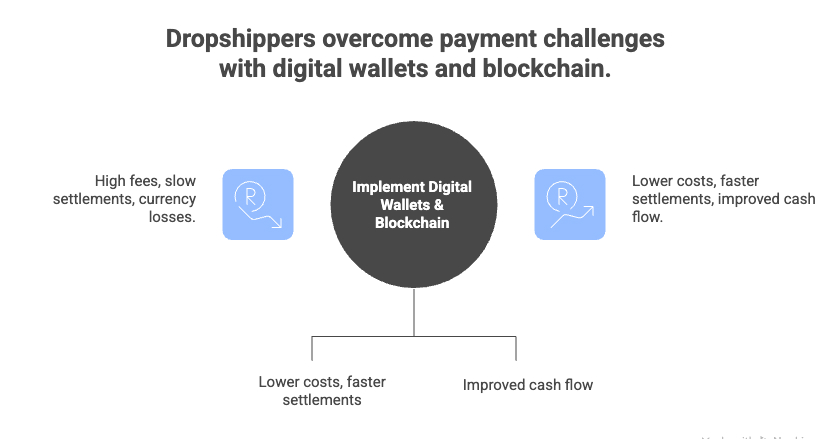
Repeated conversions are eliminated by digital wallets that hold multiple fiat currencies and stablecoins. Dropshippers can store supplier-preferred currencies, receive payments in customer currencies such as USD, EUR, and GBP, and settle quickly. This reduces foreign exchange losses to less than 0.5 percent.
Real-time tracking and settlement
Blockchain-based payments are transparent and settle within minutes. Dropshippers gain better cash flow visibility and reduce payment disputes by tracking transactions from initiation to supplier confirmation.
Endl as an Example of Smart Payment Systems
Endl and similar platforms show how these technologies work in real-world scenarios. Endl offers multi-currency wallets to dropshipping companies that support both major fiat currencies and stablecoins. These wallets integrate with e-commerce systems for customer collections and enable smooth payments to suppliers in more than 200 countries.
The hybrid model combines low-cost stablecoin transfers with compliance features such as AML and KYC. By blending blockchain speed with regulated banking rails, platforms like Endl reduce transaction costs to below 1 percent and shorten settlement timelines from days to hours.
Actual Impact on Dropshipping Businesses
Consider a US-based dropshipper sourcing products from Chinese vendors and selling across Europe.
Conventional flow
$5,000 supplier invoice paid by bank transfer
$45 wire fee
3 percent FX markup
3-day settlement delay
Total cost: $195
Optimized flow
Convert USD to USDC in a multi-currency wallet
Instant transfer to supplier
0.3 percent transaction fee
Total cost: $15
This efficiency directly improves profitability and enables faster scaling when applied across hundreds of monthly supplier payments.
Practical Advice for Dropshippers
- Reduce currency conversions by aligning supplier preferences with stablecoin or multi-currency options.
- Use platforms that integrate with e-commerce systems for automated supplier payouts.
- Monitor transaction fees and FX rates in real time across providers.
- Start optimization with high-volume supplier relationships for maximum savings.
- Ensure payment platforms comply with regulations in both sending and receiving countries.
Conclusion
As dropshipping continues to expand at a rapid pace, smarter payment solutions are becoming the standard for competitive businesses. By reducing global payment friction, these systems allow dropshippers to focus on customer acquisition, supplier partnerships, and long-term growth instead of operational bottlenecks.
Citations
-
Grand View Research. Dropshipping Market Size and Share Report, 2035.
https://www.grandviewresearch.com/industry-analysis/dropshipping-market -
Statista. Cross-Border E-Commerce Transaction Fees and Trends.
https://www.statista.com/topics/2437/cross-border-e-commerce/ -
IBM Blockchain Blog. How Blockchain Transforms International Payments.
https://www.ibm.com/blog/blockchain-in-payments/ -
Endl.io. Multi-Currency Wallets and Stablecoin Payments for E-Commerce.
https://www.endl.io/multicurrency-accoun
FAQs
Q1: Why are traditional payment methods challenging for dropshipping businesses?
Traditional payment methods create friction due to high cross-border fees, slow settlement times, FX losses, and limited supplier payment options. These issues delay fulfilment, strain supplier relationships, and reduce margins.
Q2: How do multi-currency wallets benefit dropshippers?
They allow businesses to hold, receive, and pay in multiple currencies from one account. This reduces repeated conversions, lowers FX costs, speeds up payments, and improves cash flow.
Q3: What is the advantage of blockchain-based payments in dropshipping?
Blockchain payments enable fast, transparent, and traceable transactions. Faster settlement improves working capital and reduces disputes with international suppliers.
Q4: How should dropshippers choose a payment platform?
Look for platforms with e-commerce integrations, multi-currency and stablecoin support, low FX spreads, and strong regulatory compliance. Cost transparency and reliability matter most.
Q5: What impact do smart payment solutions have on profitability?
They reduce transaction costs to below 1 percent, minimize FX losses, and cut settlement times from days to minutes, allowing dropshippers to scale while protecting margins.