Introduction
Sending money across borders is often essential for startups and small to medium-sized businesses, but it has traditionally been expensive and operationally painful. Whether paying overseas suppliers, partners, or freelancers, international payments usually involve hidden fees, slow processing, and poor exchange rates.
Modern financial infrastructure has changed this. Fintech platforms, stablecoins, and multi-currency wallets now allow businesses to move money internationally faster, cheaper, and with far more transparency.
Challenges With Traditional International Payments
Many startups and SMBs still rely on standard bank wire transfers to send money abroad. While banks offer familiarity and perceived safety, their cross-border payment systems come with structural inefficiencies.
High transfer fees
International bank wires typically cost USD 40 to 50 per transaction. Additional receiving or intermediary fees are often added, increasing the total cost.
FX markups and hidden costs
Banks commonly apply unfavourable exchange rates, with FX markups of 2 to 3 percent. Combined with wire fees, total costs often reach 3 to 5 percent of the payment value.
Slow settlement times
Cross-border bank transfers can take between one and five business days to settle. For startups managing tight cash flows, these delays can disrupt operations and strain partner relationships.
Limited transparency
Tracking international payments through correspondent banks is often unclear. Businesses may not know where funds are or when they will arrive.
For growing companies, these inefficiencies directly reduce margins and slow down international expansion.
New Alternatives for Startups and SMBs
Digital payment platforms and fintech providers have built solutions designed specifically for modern businesses. These platforms focus on three core improvements:
- Lower transaction and FX costs
- Faster settlement times
- Clear, real-time visibility into payments
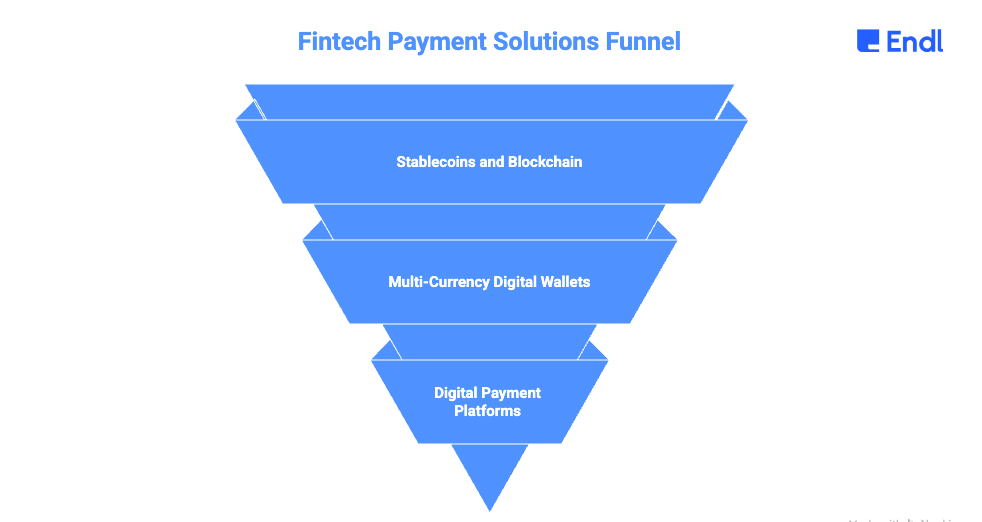
Two technologies are central to this shift: stablecoins and multi-currency digital wallets.
How Stablecoins and Blockchain Work in Cross Border Payments
Stablecoins are digital currencies pegged to stable assets such as the US dollar or euro. Because their value remains stable, they avoid the volatility typically associated with cryptocurrencies, making them suitable for business payments.
Stablecoins operate on blockchain networks such as Ethereum, Binance Smart Chain, and Solana. These networks use distributed ledgers that securely and transparently record transactions.
Key advantages include:
- Payments settle within minutes, not days
- Fewer intermediaries compared to bank wires
- Lower transaction fees
- Transparent, traceable transaction records
A business can convert local fiat currency into stablecoins, send them directly to a recipient’s wallet, and allow the recipient to convert back to local currency. This removes correspondent banks and significantly reduces FX costs.
Multi Currency Digital Wallets for Businesses and Startups
Multi-currency digital wallets allow businesses to hold, manage, and send multiple fiat currencies and stablecoins from a single account. This reduces repeated currency conversions, one of the biggest sources of hidden FX losses.
Benefits include:
- Paying suppliers and contractors in their preferred currency
- Holding funds in USD, EUR, GBP, or stablecoins without forced conversion
- Improved cash flow control
- Faster international settlements
Many platforms combine regulated banking infrastructure with blockchain payment rails. This hybrid approach delivers speed and cost efficiency while maintaining compliance and reliability.
Security, Compliance, and Risk Management
Security is critical for startups and SMBs with limited financial buffers. Blockchain technology provides strong protections through cryptographic verification and immutable transaction records.
Reputable payment platforms also implement regulatory safeguards such as:
- Know Your Customer checks
- Anti Money Laundering controls
- Transaction monitoring and reporting
These measures ensure international payments remain secure, compliant, and legally sound across jurisdictions.
How Platforms Like Endl Help
Endl is an example of a platform built around these principles. It provides businesses with multi-currency wallets that support both traditional fiat currencies and stablecoins.
By combining blockchain settlement with regulated banking rails, Endl enables:
- Faster international payments
- Transaction fees under 1 percent
- Reduced FX losses
- Built-in compliance and security controls
For startups and SMBs, this approach simplifies international payments while improving cash flow and cost predictability.
Real Impact for Startups and SMBs
Consider a US-based company paying an international freelancer €1,000 per month.
Traditional bank transfer
- Several days to settle
- Over €60 in combined fees and FX losses
Using stablecoins and a digital wallet
- Settlement within hours
- Fees under 1 percent
The result is over 90 percent cost savings, along with faster access to funds for the recipient.
Tips for Cost Effective International Payments
- Use multi-currency wallets to reduce unnecessary conversions
- Explore stablecoin payments for frequent international transactions
- Compare fee structures and FX rates across providers regularly
- Choose platforms with real-time tracking and transparent pricing
- Educate teams and partners on modern payment methods
- Ensure all providers meet security and compliance standards
Conclusion
Slow, expensive, and opaque international payments are no longer unavoidable. By adopting fintech platforms, stablecoins, and multi-currency wallets, startups and SMBs can optimize cross-border payments for speed, cost, and transparency.
This shift frees businesses to focus on growth, global partnerships, and long-term expansion with confidence.
Citations
-
World Bank. Remittance Prices Worldwide.
https://remittanceprices.worldbank.org/ -
Statista. Cross-Border Payment Fees and Fintech Trends, 2025.
https://www.statista.com/topics/871/online-payments/ -
CoinDesk. Stablecoins in Business Payments Growth.
https://www.coindesk.com/business/stablecoins-payments/ -
Endl.io. Multi-Currency Wallets for SMB International Transfers.
https://www.endl.io/business
FAQs
Q1: What are the typical costs of traditional bank wire transfers?
Traditional international bank wires usually cost USD 40 to 50 per transaction, plus FX markups of around 2 to 3 percent. Total costs often reach 3 to 5 percent, with settlement times of one to five business days.
Q2: How do stablecoins reduce international payment costs for businesses?
Stablecoins remove correspondent banks and reduce FX spreads. Payments typically settle within minutes, with fees under 1 percent.
Q3: Why are multi-currency wallets ideal for SMBs and startups?
They allow businesses to hold fiat currencies and stablecoins in one place, pay suppliers in preferred currencies, reduce conversions, and improve cash flow.
Q4: Are blockchain payments secure for business use?
Yes. Blockchain uses tamper-resistant ledgers and cryptographic security. When paired with regulated platforms following KYC and AML standards, they are both secure and compliant.
Q5: How much can businesses save using Endl for a €1,000 freelancer payment?
Fees drop from over €60 with traditional transfers to under 1 percent, with settlement completed within hours instead of days.
Q6: Which blockchain networks are best for business payments?
Ethereum, Binance Smart Chain, and Solana are widely used. They support smart contracts, fast settlement, and low cost cross-border payments.